
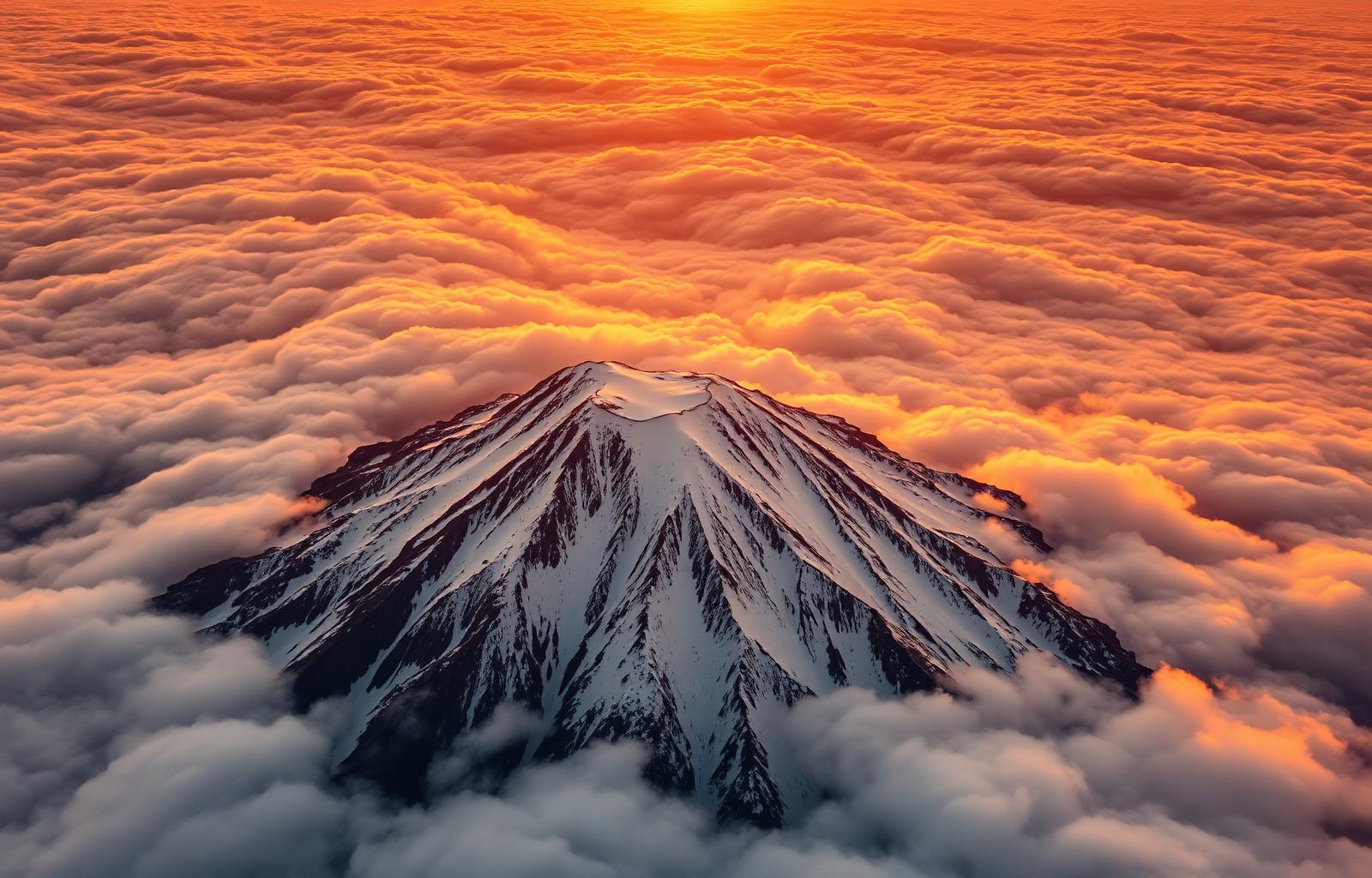
A continent's highest unsupported peak.
Kilimanjaro is the highest free-standing mountain on the planet — meaning it is not part of any mountain range. The fourth tallest of the Seven Summits and the most prominent peak in Africa, it rises roughly 4,600 m from base to summit and crowns the East African skyline alone, in a silence all its own.
"A mountain so tall, and so close to the equator, that it carries its own winter at the top."
What we call the mountain — and why.
The true meaning and origin of the name Kilimanjaro have been lost to history. The most accepted reading combines the Swahili word Kilima — mountain — with the KiChagga word Njaro, loosely translated as whiteness: the White Mountain.
Mountain
Whiteness
Spotted — for rocks on the snowfields
Freedom — for Tanzanian independence, 1961
One mountain, three histories.
Kilimanjaro is a single mountain shaped by three volcanic cones. Two are spent; one still sleeps lightly beneath the snow.
The highest cone — could one day erupt again.
The dramatic jagged sister peak to the east.
The oldest cone, now a high alpine plateau.
Ten things worth knowing.
- 01Mount Kilimanjaro is the highest free-standing mountain on the planet — 5,895 m above sea level.
- 02It is the highest mountain in Africa and the fourth highest of the Seven Summits.
- 03From base to summit it rises roughly 4,600 m (15,100 ft) — unsupported by any range.
- 04Kilimanjaro has three volcanic cones: Mawenzi, Shira (both extinct) and Kibo (dormant).
- 05Around 30,000 to 35,000 people attempt the climb every year.
- 06Only about two-thirds reach the summit — most turn-backs are altitude related.
- 07Kilimanjaro is not a technical climb — no special climbing skills are required.
- 08Many climbers fail by choosing the shorter Marangu Route (five days round-trip).
- 09Longer routes dramatically improve acclimatisation and summit success.
- 10There are seven official routes — six for ascent, one (Mweka) for descent only.
Seven ways to the roof of Africa.
Six routes lead up the mountain; one is reserved for descent. The choice of route shapes everything — pace, scenery, traffic, and most of all, your summit chances.
"The mountain doesn't ask whether you're strong. It asks whether you're patient."
Choose Your Climb
